Astara Intelligence
In Depth #91
Electric heavy truck connected to a charging station at a logistics hub at dusk
Electric · Autonomous · Heavy Freight

Two revolutions,
one truck

The electrification and autonomy of heavy freight, 2019–2026

Prepared 7 October 2026 EV + AV · 2019–2026
01The Thesis

The truck is being rebuilt twice

A heavy truck is not bought because it is exciting. It is bought because it earns money. Fleets care about cost per kilometer, uptime and utilization. That is why electrification and autonomy took longer to reach trucks than passenger cars, and why the market can move quickly once the economics work.

Revolution 1 · Electric

The electric transition is already real, but uneven.

~30%

battery-electric share of medium- and heavy-truck sales in China, 2025

€100,000 five-year saving vs diesel in the Netherlands (T&E) · about €123,000 under the diesel-price shock scenario
Revolution 2 · Autonomous

Autonomy is at an earlier stage, but its threshold has been crossed.

~20

Aurora driverless trucks in operation, June 2026

440,000
driverless miles to June 2026 Actual
>200
trucks by year-end 2026 Target
30,000
trucks by 2030 Target
Commercial driverless operations in Texas since 30 April 2025
Reported shareExpected / forecastActual reported operationsTarget company targets
The three EV shares use different metrics, markets and years, as reported by their sources; they show direction, not a like-for-like ranking. See chapter 05.

The electric transition is already real, but uneven. China is clearly ahead: battery-electric trucks represented almost 30% of medium- and heavy-truck sales in 2025. Europe reached 4.5% for zero-emission trucks above 3.5 tonnes, while the US is still expected to remain below 5% for battery-electric plus hybrid trucks in 2030.

In Europe, the most important change is economics. T&E estimates that electric trucks are already cheaper than diesel over five years in six of the nine major EU markets it analysed. In the Netherlands, for example, the saving is about €100,000 over five years, rising to roughly €123,000 under the diesel-price shock scenario.

Autonomy is at an earlier stage, but its threshold has been crossed. Aurora began commercial driverless operations in Texas on 30 April 2025. By June 2026 it reported about 440,000 driverless miles and around 20 trucks in operation, with a target of more than 200 by year-end and 30,000 by 2030. The challenge now is not proving that a truck can drive itself. It is proving that the model can scale.

That is the central tension of the whole story: technology is becoming credible faster than the business model becoming more mature.

02Electric Trucks

From promise to product

The electric truck story can now be read as a simple progression: first the announcements, then the first deliveries, then the first real products. Each phase has also exposed a different weakness in the market.

Between 2019 and 2021, manufacturers set ambitious roadmaps while start-ups attracted large amounts of capital. Traton increased investment, Volvo and Scania committed to electric ranges, Mercedes introduced the eActros LongHaul, and Nikola reached the public market through a SPAC. The 2021 T&E study was already arguing that electric was close to diesel on cost.

The next phase brought the first serious deliveries and the first failures. Volta Trucks raised €230 million in February 2022. Volvo secured major orders; Renault opened its heavy electric range for orders. Then the market turned off. Nikola cut 23% of its workforce in 2023 and Volta filed for bankruptcy in October 2023 after raising $390.9 million.

Electric tractor-trailer connected to a charging station at a depot at dusk
EV timeline
Announcements, first deliveries, real products
Product & technologyOrders, fleets & partnershipsCapital, strategy & policyFailures & retrenchmentKey milestoneTarget announced goal, not yet achieved
The announcements2019–2021
  1. 20191 event
    • Traton

      Commits billions to e-mobility

      Category: Capital, strategy & policy.
  2. 20203 events
    • Nikola

      Goes public via SPAC, opening the 2020–21 capital wave

      Category: Capital, strategy & policy. Key milestone.
    • Mercedes-Benz Trucks

      Unveils the eActros LongHaul: long-haul enters OEM roadmaps

      Category: Product & technology.
    • Volvo Trucks

      Pledges to electrify its entire line-up

      Category: Capital, strategy & policy.
  3. 20211 event
    • Transport & Environment

      Study: electric trucks close to cost parity with diesel

      Category: Capital, strategy & policy. Key milestone.
First deliveries, first failures2022–2023
  1. 20224 events
    • Volta Trucks

      Closes a €230M round, the peak of European e-truck start-up funding

      Category: Capital, strategy & policy. Key milestone.
    • Volvo Trucks

      Receives a record electric-truck order from Maersk

      Category: Orders, fleets & partnerships.
    • Renault Trucks

      Opens its heavy electric range for orders

      Category: Product & technology.
    • Tesla

      Starts Semi deliveries, first to PepsiCo

      Category: Product & technology. Key milestone.
  2. 20233 events
    • Nikola

      Cuts 23% of its workforce

      Category: Failures & retrenchment.
    • Mercedes-Benz Trucks

      40-tonne eActros 600 drives 1,000 km with a single charging stop

      Category: Product & technology.
    • Volta Trucks

      Files for bankruptcy after raising $390.9M

      Category: Failures & retrenchment. Key milestone.
Real products2024–2026
  1. 20241 event
    • Amazon

      Puts its first electric semis into freight operations

      Category: Orders, fleets & partnerships.
  2. 20254 events
    • Nikola

      Files for Chapter 11; peak market value was ~$26–30B in 2020

      Category: Failures & retrenchment. Key milestone.
    • Harbinger

      Raises a $160M Series C co-led by FedEx

      Category: Capital, strategy & policy.
    • Bollinger Motors

      Shuts down amid financial woes

      Category: Failures & retrenchment.
    • Kenworth / Peterbilt

      Launch new electric trucks for North America

      Category: Product & technology.
  3. 20269 events
    • Tesla

      Semi's first truck rolls off the high-volume production line

      Category: Product & technology. Key milestone.
    • Tesla

      Confirms an 822 kWh battery for the Semi

      Category: Product & technology.
    • Windrose

      Tesla Semi challenger reported to be missing paychecks and a truck

      Category: Failures & retrenchment.
    • Mars / Rewe

      Deploy 47 battery-electric trucks on a shared pilot corridor

      Category: Orders, fleets & partnerships.
    • Amazon

      Receives its first eActros 600 trucks in Germany

      Category: Orders, fleets & partnerships.
    • BYD

      Brings the ETT 44 to Europe: 600 km range, 20-minute charge

      Category: Product & technology. Key milestone.
    • Volvo Trucks

      Starts production of the FH Aero Electric

      Category: Product & technology. Key milestone.
    • Scania

      Announces a battery solution for 720 km of range

      Category: Product & technology.
    • FedEx / Harbinger

      FedEx orders 2,000 electric trucks in a $300M deal

      Category: Orders, fleets & partnerships.
From 2019 roadmaps and early funding to series production, longer-range trucks and the arrival of Chinese entrants in Europe. Selection of events from the Astara Intelligence truck database; key milestones are the turning points named in the text.

By 2024–2026, the discussion had shifted from whether electric trucks could work to what the best commercial product would look like. Mercedes demonstrated a 40-tonne eActros 600 over 1,000 km with one charging stop. Tesla moved the Semi into high-volume production with an 822 kWh battery. BYD brought the ETT 44 to Europe with 600 km of range and a 20-minute charge. Scania announced a 720 km battery solution, while Volvo moved the FH Aero Electric into production. At the same time, Chinese manufacturers began to compete more directly on price: T&E puts a Chinese-built electric truck at about €210,000 versus €265,000 for a comparable European model.

Price pressure
A Chinese-built electric truck vs a comparable European model

€55,000 gap · the Chinese-built truck is about 21% cheaper

Source: Transport & Environment (T&E), 2026. Prices are approximate, as reported.

So, the question is changing. The issue is no longer whether electric trucks can replace diesel in principle. It is where the economics are already better, how quickly infrastructure catches up and how much pressure lower-cost Chinese products put on established manufacturers.

03Autonomous Trucks

From pilot to driverless

Autonomous trucking followed a more dramatic path. In 2019–2021, the sector was full of pilots, partnerships, and public-market excitement. Starsky Robotics was already testing uncrewed trucks in 2019. TuSimple, Aurora, Embark, Plus, Kodiak and Gatik all worked with major carriers. TuSimple raised $1.35 billion in its 2021 IPO, while Embark and Aurora reached the public markets through SPAC deals.

Then the model was tested by reality. Embark went from a $5 billion SPAC valuation to a sale for about $71 million in 2023. Waymo paused its trucking programme. TuSimple closed its US operations. These were not failures of the concept alone. They were failures of timing, capital intensity, commercial scale, or some combination of the three.

These were not failures of the concept alone.

From the analysis
AV timeline
Pilots, public-market excitement, reality check, driverless freight
Product & technologyOrders, fleets & partnershipsCapital, strategy & policyFailures & retrenchmentKey milestoneTarget announced goal, not yet achieved
Pilots and experiments2019–2020
  1. 20192 events
    • Daimler Truck

      Buys a stake in Torc Robotics

      Category: Capital, strategy & policy. Key milestone.
    • Starsky Robotics

      Runs the first uncrewed truck at highway speed (55 mph)

      Category: Product & technology. Key milestone.
  2. 20202 events
    • Starsky Robotics

      Shuts down after failing to find a buyer or investors

      Category: Failures & retrenchment.
    • Waymo / Daimler Truck

      Waymo Driver is to power Daimler trucks

      Category: Orders, fleets & partnerships.
Public-market excitement2021
  1. 20216 events
    • Volvo / Aurora

      Partner on autonomous transport solutions

      Category: Orders, fleets & partnerships.
    • TuSimple

      IPO raises $1.35B, peak of the AV-trucking capital cycle

      Category: Capital, strategy & policy. Key milestone.
    • Embark

      Announces a SPAC deal at a $5.2B valuation

      Category: Capital, strategy & policy. Key milestone.
    • Aurora

      Lists on Nasdaq via SPAC, ~$1.8B gross proceeds

      Category: Capital, strategy & policy. Key milestone.
    • TuSimple / Navistar / DHL

      Sell 100 self-driving trucks to DHL

      Category: Orders, fleets & partnerships.
    • TuSimple

      Completes its first driverless run on public roads

      Category: Product & technology.
Tested by reality2022–2024
  1. 2022No selected events
  2. 20234 events
    • Waymo Via

      Pauses its trucking programme

      Category: Failures & retrenchment. Key milestone.
    • Embark

      Sold to Applied Intuition for ~$71M, about 1% of its SPAC valuation

      Category: Failures & retrenchment. Key milestone.
    • Pony.ai

      Wins its first autonomous trucking licence in Guangzhou

      Category: Capital, strategy & policy.
    • TuSimple

      Winds down its US operations

      Category: Failures & retrenchment. Key milestone.
  3. 20242 events
    • Aurora / Uber Freight

      Sign a long-term driverless truck deal after a pilot

      Category: Orders, fleets & partnerships.
    • Volvo / DHL

      Begin autonomous truck operations

      Category: Orders, fleets & partnerships.
Driverless on real freight lanes2025–2026
  1. 20255 events
    • Waabi / Volvo

      Partner on the Volvo VNL Autonomous

      Category: Orders, fleets & partnerships.
    • Aurora

      Launches commercial driverless operations in Texas

      Category: Orders, fleets & partnerships. Key milestone.
    • Kodiak

      Lists via SPAC

      Category: Capital, strategy & policy.
    • Einride

      Completes the world's first autonomous border crossing

      Category: Orders, fleets & partnerships.
    • Einride

      Announces a SPAC with Legato at a $1.8B valuation

      Category: Capital, strategy & policy.
  2. 202610 events
    • Gatik

      Operates fully driverless trucks at commercial scale

      Category: Orders, fleets & partnerships. Key milestone.
    • Waabi

      Raises a $750M Series C, the largest private AV-truck round in the set

      Category: Capital, strategy & policy.
    • PlusAI

      SPAC business combination terminated

      Category: Failures & retrenchment.
    • California DMV

      Finalises rules opening the state to heavy-duty autonomous trucks

      Category: Capital, strategy & policy.
    • AuroraTarget

      Selected by a leading carrier to scale to 500 trucks

      Category: Orders, fleets & partnerships.
    • VolvoTarget

      Targets a $3B autonomous business within five years

      Category: Capital, strategy & policy.
    • Einride / Lidl

      Launch the first cab-less truck on a German public road

      Category: Orders, fleets & partnerships. Key milestone.
    • Pony.ai / GAC

      Unveil the Gen-4 robotruck, with European sales targeted

      Category: Product & technology.
    • AuroraTarget

      Targets 30,000 driverless trucks by 2030, from about 20 today

      Category: Capital, strategy & policy. Key milestone.
    • KodiakTarget

      Picks Dallas–Houston for its driverless long-haul launch

      Category: Orders, fleets & partnerships.
The path from pilots and SPACs to commercial driverless freight, with failures and pauses visible alongside the launches. Selection of events from the Astara Intelligence truck database; key milestones are the turning points named in the text.

The more recent phase is different. Partnerships have become more operational, and driverless service has moved onto real freight lanes. Aurora launched commercial driverless operations in Texas in April 2025 and has expanded across Texas, New Mexico and Arizona. Gatik reached fully driverless commercial delivery at scale in January 2026. Kodiak is targeting a driverless long-haul launch with IKEA, while Einride and Lidl deployed a driverless cab-less truck on German public roads in September 2026. Pony.ai is also expanding its robotruck activity in China and targeting Europe.

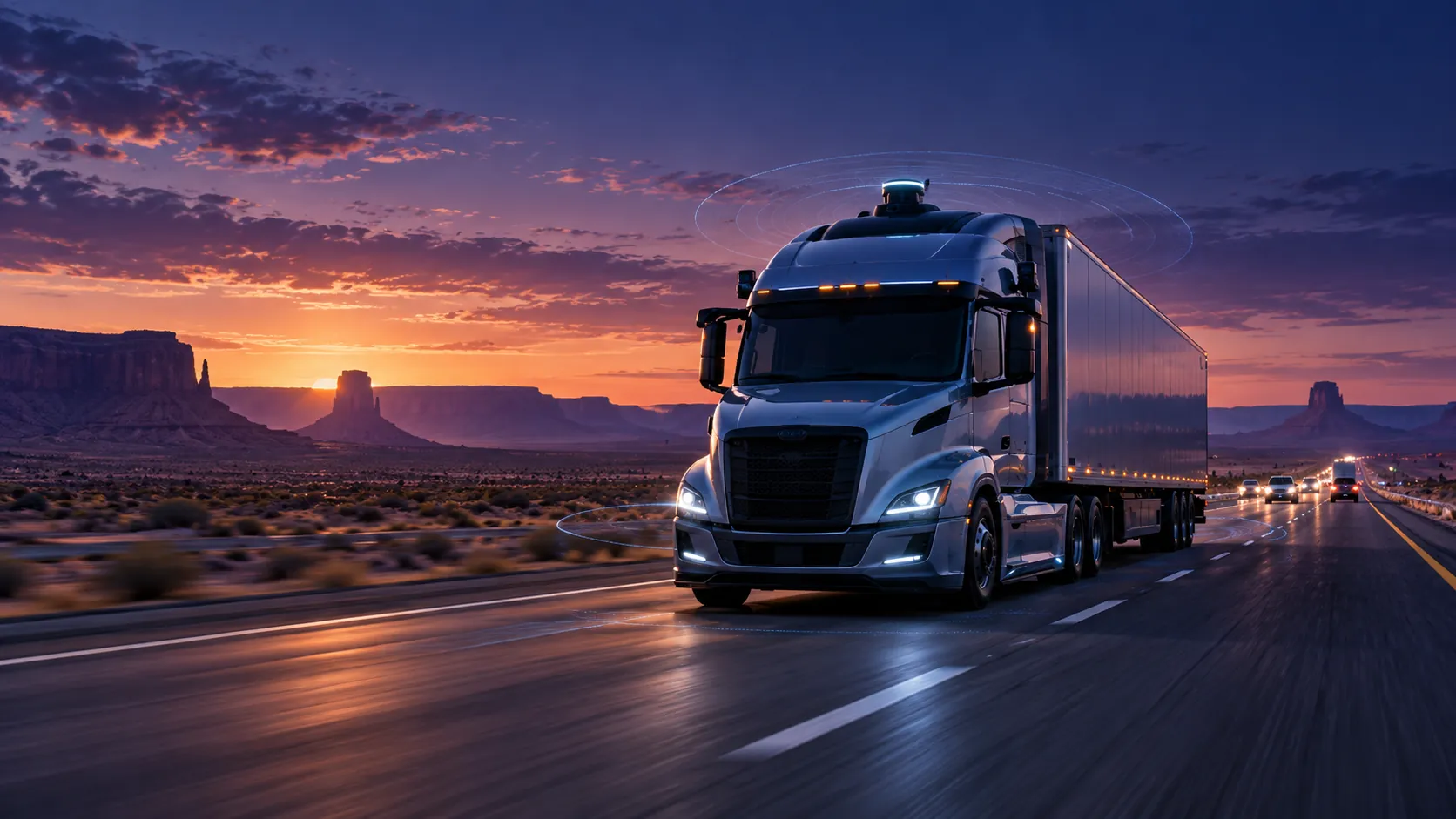
Autonomous tractor-trailer with roof-mounted sensors driving on a desert highway at sunset

But the scale gap remains enormous. Around 20 commercial driverless trucks today against a target of 30,000 by 2030 means the industry still must grow by roughly 1,500 times. That is why the next few years matter more than the previous few: the question is no longer whether autonomous trucks can work, but whether operators can deploy them fast enough to make the economics compelling.

The scale gap
Aurora today vs Aurora's own targets: one square = one truck
~20 trucks
Actual commercial driverless trucks in operation (June 2026), after ~440,000 driverless miles
>200 trucks
Target by year-end 2026
30,000 trucks
Target by 2030
Growth needed from today to the 2030 target≈1,500×
Targets are company statements, not forecasts by Astara Intelligence. The squares are drawn to scale. Source: Aurora disclosures and press reports, 2025–2026.
04The Shake-out

Capital creates winners and losers

The funding history tells a useful story. Autonomous trucking attracted far more disclosed capital than electric trucks in this dataset: about $6.4 billion from 2021 to 2026 versus about $1.3 billion for electric trucks. More than half of the autonomous total came from the 2021 listing wave.

Funding by year
One listing wave, then a smaller and more selective second wave
AV · SPACs & public offeringsAV · ventureEV · venture
Disclosed capital raised from 2021 to 2026. The 2021 autonomous funding wave stands out, followed by a smaller and more selective second wave. Only deals with a disclosed amount are counted (2023 has none); 2026 is year to date. EUR and CNY converted to USD at ECB reference rates on the deal date. Source: company announcements, SEC filings and press reports; Astara Intelligence database.

That money created scale, but it also created inflated expectations. Embark went from a $5.2 billion SPAC valuation to a roughly $71 million sale. Nikola reached a peak market value of around $26–30 billion before filing Chapter 11. Volta Trucks failed after raising $390.9 million. TuSimple raised $1.35 billion in its IPO and still exited the US.

Exits and failures
Initial ambition vs eventual outcome

Each figure is labelled by what it measures: market value, valuation at listing, capital raised and acquisition price are different things and are not interchangeable.

Other exits and setbacks
    The casualties of the 2020–2021 funding wave, showing how quickly valuations and ambitions could collapse. Status as of October 2026. Source: company filings, FreightWaves, Bloomberg, WSJ, TechCrunch; Astara Intelligence database.

    The more resilient companies are the ones that continued to raise capital while moving toward a real commercial product. Aurora, Kodiak, Waabi, Gatik and Einride all raised, listed or completed a PIPE in 2025–2026. But the lesson is not that funding guarantees survival. It does the opposite: it buys time to prove the model. Partnerships help, but they are not enough on their own. TuSimple had relationships with Traton, Navistar and DHL and still left the US.

    05Where the Market Is Moving

    Not one global transition, but three

    China

    Electric at scale

    126,200new-energy heavy trucks sold in H1 2026, up 85% year on year · plus 1.6 million new-energy heavy trucks targeted by 2030

    Scale 0–50%. Actual = battery-electric share of medium- and heavy-truck sales; target = new-energy heavy-truck penetration.

    The market is not developing at the same speed everywhere. China has moved fastest on electric trucks because economics, industrial policy and infrastructure are reinforcing each other. In the first half of 2026, new-energy heavy-truck sales reached about 126,200, up 85% year on year, while China is targeting 40% penetration and 1.6 million new-energy heavy trucks by 2030.

    Europe

    Regulation-led

    EU heavy-duty CO₂ targets Target
    203020352040
    ~100,000new zero-emission trucks a year for 2030 (ACEA)
    ~50,000public chargers, incl. 35,000 megawatt points
    700hydrogen stations

    Europe is moving more slowly, but with stronger regulatory pressure. Electric trucks are becoming more competitive on total cost, while the EU is still committed to heavy-duty carbon-dioxide targets of -45% by 2030, -65% by 2035 and -90% by 2040. The problem is infrastructure. ACEA estimates that reaching the 2030 target will require roughly 100,000 new zero-emission trucks a year, around 50,000 public chargers including 35,000 megawatt charging points, and 700 hydrogen stations.

    United States

    Two speeds

    ↘
    ElectricFederal incentives for clean commercial vehicles reduced or removed; battery-electric plus hybrid trucks expected below 5% of sales in 2030.
    ↗
    AutonomousRegulation becoming more open: Aurora driverless in Texas since April 2025; California finalised rules opening the state to heavy-duty autonomous vehicles in 2026.

    The US is taking a different path. Federal incentives for clean commercial vehicles have been reduced or removed, while the regulatory environment is becoming more open to autonomous trucks. That creates a market where electric adoption can slow even as autonomous freight accelerates. The result is not one global transition, but three different versions of it.

    The company map reflects that geography. The US remains the main autonomous cluster, China is the strongest electric market, and Europe sits between the two, with incumbent truck manufacturers and a growing group of start-ups trying to combine electrification, software and autonomy.

    Company map
    Where the companies in the database are based
    Circle size = database coverage. It counts the company profiles held in the Astara Intelligence database, plus the main truck OEMs, per region. It is not market size, sales or regional leadership.
    Electric (EV)Autonomous (AV)Both (EV + AV)
    A world view of the main companies in the ecosystem, showing how the US and China have developed different centres of gravity. Regions are drawn at an approximate centre. Cleaning applied to the source table: three duplicate profiles removed (Torc, Kodiak, Senior Auto / Sinian Zhijia) and two countries assigned (Bollinger Motors: US; Rideflux: South Korea). Some EV profiles are van, bus or light-vehicle makers.
    06Convergence

    The two revolutions are starting to converge

    Electric and autonomous trucks are not separate stories. The same companies increasingly operate across both layers, and the same customers appear in both ecosystems. Einride has built its proposition around electric and autonomous freight from the start. Volvo is active in both and works with Aurora, Waabi and DHL. Daimler Truck combines electric products with Torc. Pony.ai is developing its latest robotruck with GAC.

    This is important because the eventual winner may not be the company with the best battery or the best autonomous software in isolation. It may be the company that can bring the whole system together: vehicle, software, charging, fleet operations, and paying customers.

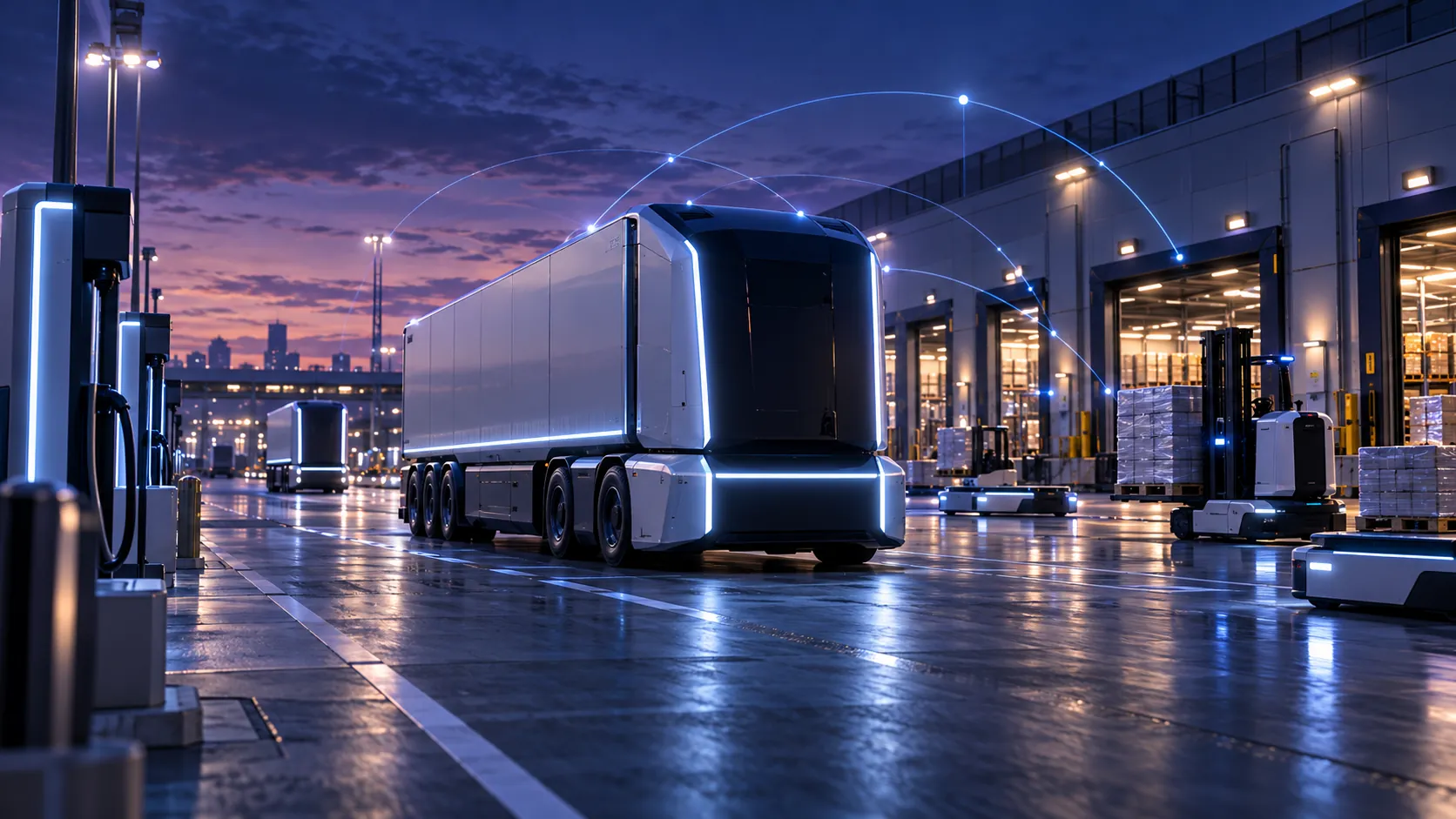
    Cab-less autonomous truck, charging stations and automated warehouse vehicles linked by connectivity arcs
    Alliances
    Truck makers, autonomous developers and the freight customers they serve

    Six companies tie both revolutions together. Their relationships are drawn in full; every other tie is shown fainter.

    Truck OEMTech / energy supplierDeveloper / operatorShipper / carrier Ties in both EV and AV AV tieEV tieEV and AV tie
    The network linking truck makers, autonomous developers and large freight customers. The strongest relationships increasingly connect both EV and AV. Partnerships and orders 2019–2026 from the Astara Intelligence database; not exhaustive. On larger screens, hover or tap a company to isolate its ties.

    The alliance network makes that visible. OEMs remain the industrial anchors, autonomous developers provide the software layer, and shippers and logistics companies provide the routes and the demand. Volvo and Einride are particularly interesting because they sit between several parts of the ecosystem. The recurring customers, including DHL, FedEx, Amazon, Walmart and PepsiCo, also show that the same large fleets are watching both revolutions at once.

    07What Matters Next

    Less announcement, more proof

    The next phase will be judged less by announcements and more by proof.

    1. 01
      Autonomy · scale

      Can Aurora move from around 20 trucks to more than 200?

    2. 02
      Autonomy · long haul

      Can Kodiak launch a reliable long-haul service?

    3. 03
      Electric · cost and charging

      Can electric trucks keep improving their cost advantage while charging infrastructure catches up?

    4. 04
      Electric · competition

      Can Chinese manufacturers enter Europe at lower prices without turning the market into a race to the bottom?

    5. 05
      Capital

      And can new companies still access public capital after the hangover from 2021?

    For fleets, the decision is becoming practical, especially by economics proofs. If these vehicles show a better balance in Total cost of Ownership (TCO) or Total Cost of Management (TCM), operators will look at it and take them as driver of buying. Electric trucks are increasingly a question of route economics and charging availability. Autonomous trucks are increasingly a question of utilisation, labour substitution and whether driverless miles can be scaled reliably. For manufacturers, the challenge is broader: they must manage both transitions while protecting margins and adapting to a market in which software, capital and partnerships matter almost as much as the truck itself.

    Conclusion

    The simple conclusion is that both revolutions have moved beyond the “will it happen?” stage. Electrification is already commercial in the right market. Autonomy has reached commercial service, but not yet on a commercial scale. The winners of the next cycle will be the companies that can turn technological progress into repeatable economics.